_1.png)



 back
back


Learning & Teaching News
Michael Swanborough
Deputy Principal – Learning and Teaching


Understanding How Your Child Learns:
The Gradual Release of Responsibility Model
Last year in the Newsletter we looked at the Learner Attribute section of our College Pedagogical Framework and the four key areas – Engaging, Relating, Developing and Managing. This year I want to unpack the Gradual Release of Responsibility instructional framework and the High Impact Teaching Strategies which complement and support this framework.
At St Andrews Christian College, our teachers use a research-backed approach to learning called the Gradual Release of Responsibility model. This model provides a structured framework that gradually shifts the responsibility for learning from the teacher to the student, moving through four key stages: Focussed Instruction, Guided Instruction, Collaborative Learning, and Independent Learning.
The diagram below shows the four stages of the Gradual Release of Responsibility model:
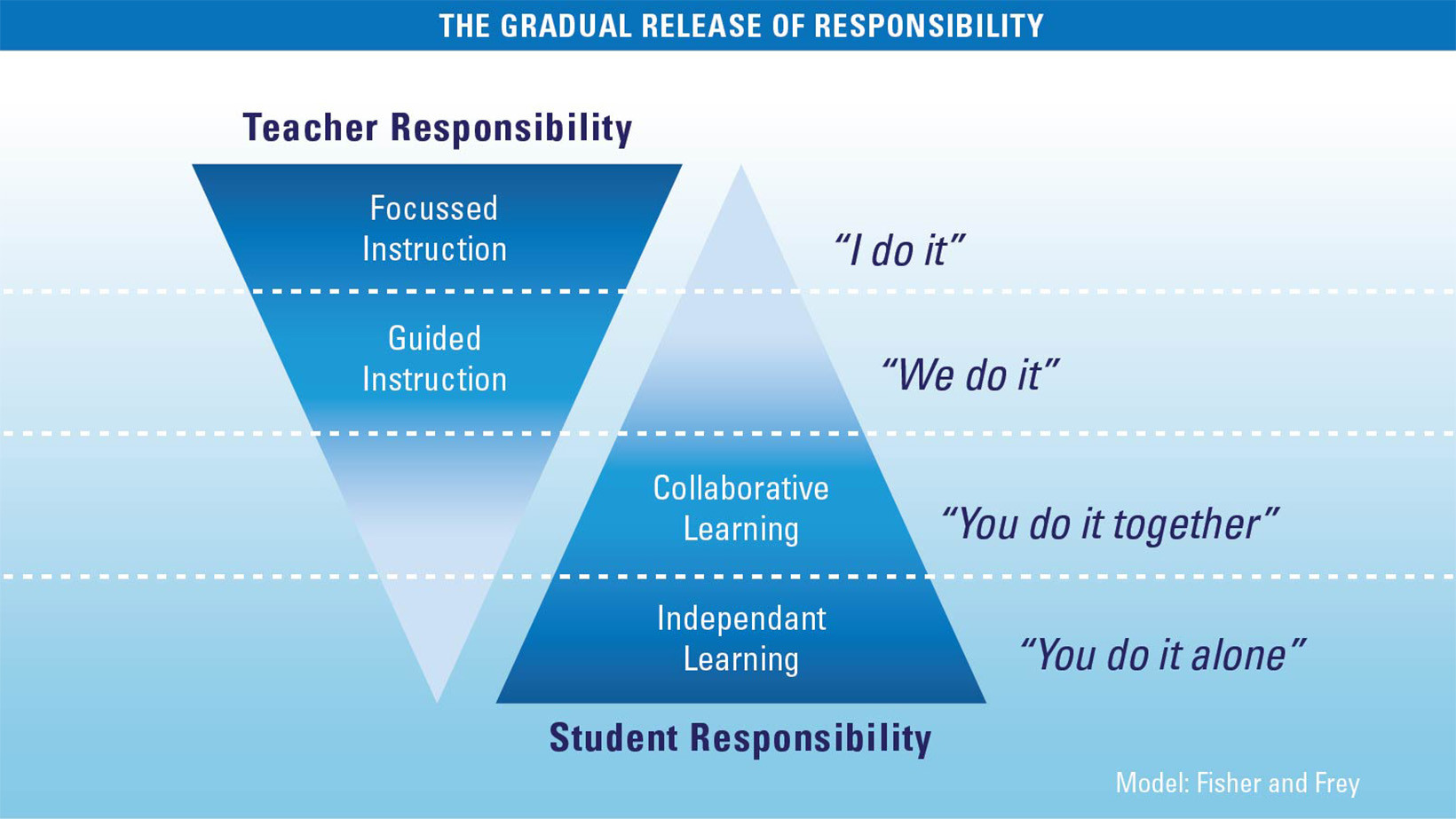
Rather than following a strictly linear path, the process is dynamic. Teachers move back and forth between stages, alternating guided practice with independent attempts, until each student is ready to take full ownership of their learning. The ultimate goal is for students to be able to apply what they have learned in new and different situations.
STAGE ONE:
Focussed Instruction — " I Do It"
The first stage of the model is Focussed Instruction, and it forms the foundation of every lesson at the College.
Supported by research from the Australian Education Research Organisation (AERO), this stage is based on the principle that students learn new material most effectively when it is introduced clearly, broken into manageable pieces, and explicitly explained and demonstrated by the teacher. Rather than expecting students to discover or piece together new knowledge on their own, the teacher takes the lead, modelling the thinking, skills, and processes that students need to learn.
Starting with Clear Goals
One of the first things teachers do in this stage is share the lesson's learning intentions and success criteria with students. In simple terms, this means telling students what they are going to learn and what success looks like. Clear learning intentions help students focus on what matters most, while success criteria give them a roadmap and a way of knowing whether they are on the right track. Teachers also highlight which of the St Andrews Christian College Learner Attributes are most relevant to the lesson.
Keeping It Focussed
During Focussed Instruction, teachers are deliberate about keeping explanations brief and clear. This is intentional. When students are introduced to too much information at once, it can be overwhelming and actually hinder learning. By limiting unnecessary content and focusing on the essentials, teachers help students absorb and understand new material more deeply.
Explanations are also made interactive with teachers regularly pausing to ask questions and check that students understand before moving forward. This not only keeps students engaged, but also gives teachers valuable feedback about when the class is ready to move on to the next stage of learning.
Learning by Watching an Expert Think
A key part of Focussed Instruction is teacher modelling, where the teacher thinks aloud and demonstrates how an expert approaches a task or problem. This gives students a window into the thinking process, not just the end result. Over time, this supports students in developing their own ability to reflect on and regulate their learning, a skill researchers call metacognition.
Teachers also make use of worked examples, walking students step-by-step through how a problem is solved. This approach prevents students from feeling overwhelmed, allows them to focus on understanding the process, and helps connect abstract concepts to real-world situations.
Setting the Stage for What Comes Next
Focussed Instruction is just the beginning. Once students have been explicitly taught the new knowledge or skill, they are ready to move into Guided Instruction and Collaborative Learning, where teachers and students work through tasks together, and eventually toward Independent Learning.
I look forward to sharing more about these stages in future newsletters.
Michael Swanborough
Deputy Principal – Learning and Teaching

CSA Teaching & Learning Network Meeting
We were delighted to host the first CSA Teaching and Learning Network Meeting for 2026 at St Andrews Christian College. It was wonderful to gather and share the inspiring work taking place each day in classrooms across CSA schools. Our team appreciated the opportunity to share our journey in developing and implementing the College Pedagogical Framework, and we look forward to gathering again in Term 2 at Crest Education.



Learning Support News
Term 1 has been an exciting and busy time for our students as they settled into their new classes, built friendships, and got to know their teachers. This term, we enjoyed celebrating student learning and progress during Student Support Group meetings, and greatly valued the opportunity to work closely with parents to plan together for continued growth and development.
This term, we held one ASD Parent Support Group meeting, where families shared insights about returning to school and the role that daily routines play in supporting children and young people. The phrase that resonated most with everyone was “connection before direction”, reinforcing how vital relationships are in supporting positive outcomes.
Our Term 2 meetings will be on Tuesday 5th May and Wednesday 17th June at 9:15am at the Taste & See Cafe.
Topics for discussion will be:
- Tuesday 5th May will be ‘The Problem of Masking’
- Wednesday 17th June – Principal Nick Haines will be sharing some of his journey.
The primary aim is to provide parents with the opportunity to connect with others facing the challenges of raising a child with autism. Everyone is welcome, and we look forward to seeing you there.
Neurodiversity Celebration Week
March 16 – 22
The term ‘neurodiversity’ is often used to describe the natural variation in the way an individual’s brain functions. It refers to the differences in the way people behave, and how they experience, understand and interact with the world around them.
During Neurodiversity Celebration Week, staff and students reflected on the truth that we are fearfully and wonderfully made.
The week focused on celebrating individual strengths and recognising the natural differences in how people think, learn, and experience the world.
Neurodiversity includes differences such as dyslexia, autism, ADHD, and dyspraxia, reminding us that everyone has unique strengths and challenges. Through shared picture storybooks, classroom resources, and discussions, our community grew in understanding and appreciation of these differences.
As we celebrate diverse abilities, we are reminded that each person is uniquely created by a faithful and loving God. By honouring differences and supporting one another, we grow together as a community. This diversity enriches our school and deepens our understanding of how each of us belongs within God’s family.
Shirley Gillie – Head of Learning Support
sgillie@standrews.vic.edu.au
Fiona Porter – Learning Support Teacher – Primary
fporter@standrews.vic.edu.au
Kerryn Terrington – Learning Support Teacher – Secondary
kterrington@standrews.vic.edu.au
Shirley Gillie
Head of Learning Support