_1.png)



 back
back


Learning & Teaching News
Michael Swanborough
Deputy Principal – Learning and Teaching


Understanding How Your Child Learns:
The Gradual Release of Responsibility Model
At St Andrews Christian College, our teachers use a research-backed approach to learning called the Gradual Release of Responsibility model. This model provides a structured framework that gradually shifts the responsibility for learning from the teacher to the student, moving through four key stages: Focussed Instruction, Guided Instruction, Collaborative Learning, and Independent Learning
The diagram below shows the four stages of the Gradual Release of Responsibility model:
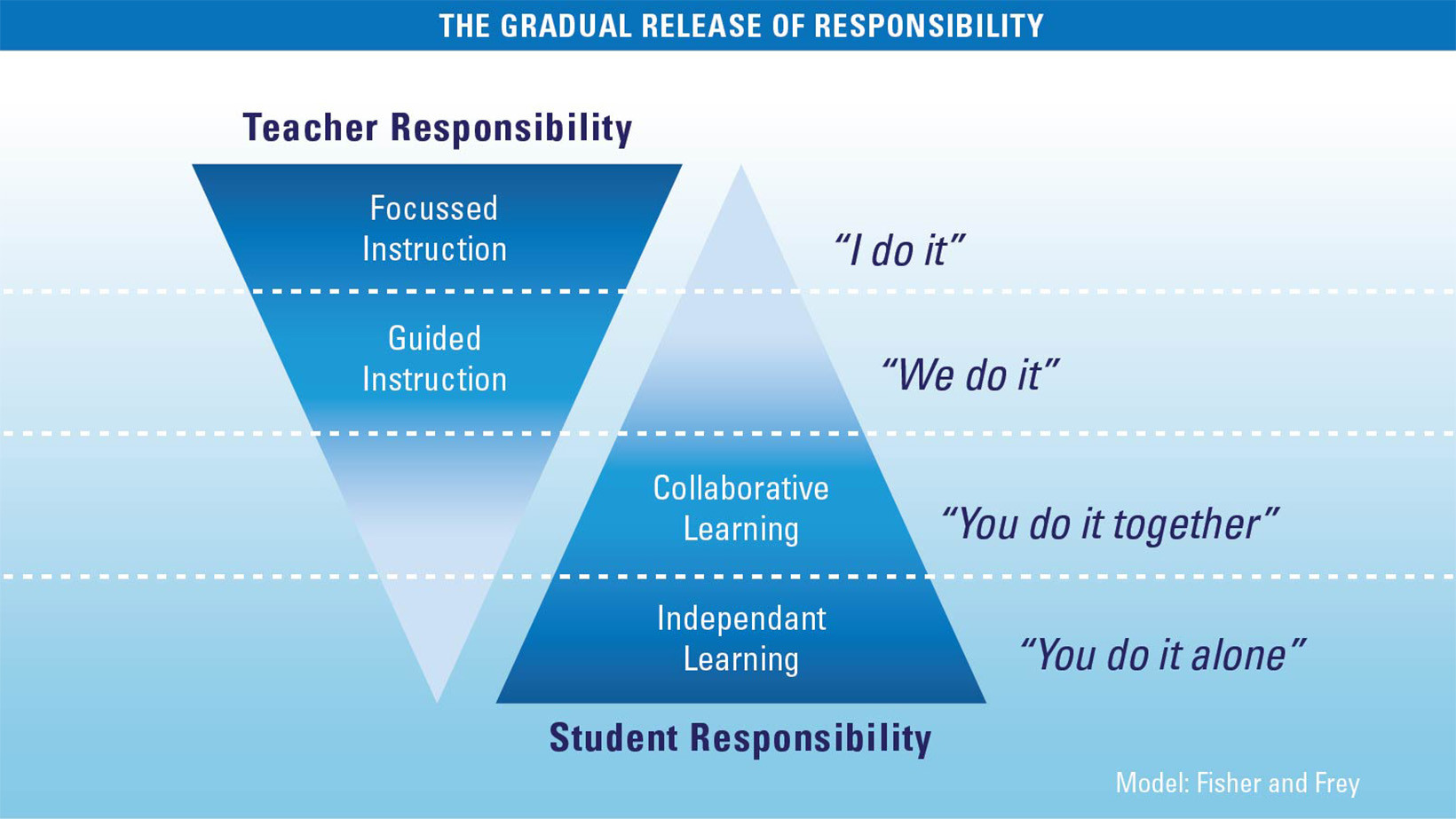
In the Term 1 Newsletter, we looked at the first stage of the Gradual Release of Responsibility model: Focussed Instruction – “I Do It” where the teacher takes the lead in introducing new knowledge and skills. We explored the elements of: Starting with Clear Goals, Keeping it Focussed, Learning by Watching an Expert Think and Setting the Stage for What Comes Next. This term I want to look at the second stage of the model: Guided Instruction – “We Do It.”
STAGE TWO:
Guided Instruction — "We Do It"
Once students have been introduced to new content through Focussed Instruction, they are ready to move into Guided Instruction. This is the stage where the teacher begins to step back a little, and invites students to start practising new skills with carefully targeted support. Rather than simply watching and listening, students now begin to have a go, while the teacher remains close by to guide, prompt, and redirect as needed.
The Bridge Between Modelling and Independence
Guided Instruction is not about students working independently; that comes later. Instead, it is a supported rehearsal stage; the bridge between the teacher demonstrating a skill and students applying it on their own. Research by educational psychologist Barak Rosenshine confirms that new learning is fragile and can be quickly forgotten without sufficient practice. Effective teachers understand this, and deliberately spend more time in this guided phase, working through problems with students together, co-constructing understanding, and prompting students to explain their thinking.
This is not passive learning. Students might be asked to explain a step to a partner, solve a problem, or identify where a worked example has gone wrong. Each of these activities deepens understanding and helps learning move from short-term working memory into long-term memory.
Meeting Students Where They Are
One of the most powerful tools a teacher uses during Guided Instruction is purposeful questioning. Rather than simply asking “Does everyone understand?”, a question that rarely reveals much, skilled teachers ask targeted questions that make every student’s thinking visible: “What do you notice here?” “What would happen if we tried it this way?” “Can you explain why you took that step?” The emphasis is on guiding students toward deeper understanding rather than simply giving them the answer.
These checks for understanding are diagnostic tools. They help the teacher see in real time who has grasped the concept, who is nearly there, and who needs a little more support before moving on. Rosenshine’s research shows that the most effective teachers check for understanding frequently and consistently throughout this phase, rather than waiting until the end of a lesson to find out what students have or haven’t learned.
At St Andrews Christian College, this often involves teachers working with small groups while other students engage in collaborative or independent tasks. If a check for understanding reveals that most students are ready to move forward, the teacher can do so with confidence. If common errors or misconceptions emerge, the teacher can pause and reteach before those misunderstandings become habits.
Building Confidence and Independence
There is an important reason this stage sits at the heart of the Gradual Release model. When students attempt a task with the right level of support they begin to build both competence and confidence. They experience the satisfaction of working through a challenge and succeeding, which in turn motivates them to keep trying. Over time, this guided practice develops the skills and self-belief students need to eventually work independently.
Guided Instruction is a reminder that learning is not a solo pursuit; it flourishes in the space between teacher expertise and student effort.
Next term, I look forward to sharing more about the third stage of the model: Collaborative Learning – “You Do It Together”.
Michael Swanborough
Deputy Principal – Learning and Teaching

VEX Robotics World Championship
Our Robotics teams returned from an incredible experience earlier this term competing at the 2026 VEX Robotics World Championships in St Louis, USA, where they represented Australia against the world's best teams. After several days of preparation and practice with local schools, our students entered the competition ready to test themselves on the international stage, while also building valuable friendships with teams from around the world.
Our High School team (3477C) demonstrated outstanding perseverance, continually refining their robot and autonomous programming throughout the competition. As they adapted to the exceptionally high standard of international competition, they finished the qualifying rounds with a strong record that ranked among the best-performing Australian teams at the event. The Middle School team (3477B) also impressed with consistent autonomous performances, exceptional driver skill and determined defence, competing strongly in a highly competitive field and narrowly missing victory in several close matches.
Beyond the competition results, the World Championships provided an invaluable learning opportunity. Through countless hours of practice, collaboration with teams from across the globe, and the generous hospitality of local schools in St Louis, our students developed not only their technical skills but also resilience, teamwork and sportsmanship. We congratulate all four students on representing the College with excellence and look forward to seeing how this experience strengthens our Robotics program in the years ahead.
Brendan Hennessy
Secondary School Teacher



CSEN Public Speaking Championships
Secondary
On Tuesday 12 May, St. Andrews Christian College hosted the Secondary CSEN Public Speaking Championships for the second year running. The schools who attended were full of praise for the friendly and inviting atmosphere at St Andrews. Both the Senior Secondary and Junior Secondary team worked hard in the weeks leading up to the competition, meeting during Lunch on Tuesdays to practice both prepared and impromptu speeches. The hard work paid off, as the Junior Secondary team, consisting of Adlyn Tan, Chloe Law, Raquel Thor, Megan Lien, Maia Yarlett and Isla McMahon claimed victory. Well done to all our brave speakers!
Christa Cloete
Head of English, Year 7/8 Coordinator


Primary
On Wednesday 13 May, St Andrews hosted the CSEN Public Speaking Competition, where a team of five Year 6 students proudly represented the school.
Aaron Chen, Jamie Cho, Maylis Mestry, Sarah Ng and Joyce Xu each participated in both a prepared speech and an impromptu speech, demonstrating confidence, strong communication skills and the ability to think on their feet.
We praise God for their talents and the wonderful way they represented the school.
Emily Gan
Primary School Teacher