_1.png)



 back
back


Principal's Message
Nick Haines
College Principal

Welcome to our Term 3 Newsletter and I hope it provides you with valuable and insightful reading in which we share many of the positive things that have been happening in the life of the College throughout the term.
It was a great delight to be able to share with our community about the news of the College intending on purchasing additional land with the view to commence an additional campus in 2030. The feedback from families has been overwhelmingly positive about this news, and I view this as confirmation of the College Board and Executive Leadership team stepping out in faith in following God’s calling for us to grow His kingdom through Christian education. Since communicating this news in July, we have continued to make positive progress toward enacting our plans. With this in mind, allow me to use this newsletter as an opportunity to provide an update on the progress of this exciting news. To provide some structure to this, I will share with families what work has been done over the past 12 months, where we are currently positioned and what the coming years ahead look like as we plan the commencement of an additional campus in 2030.
In June 2025, the College commenced initial conversations with the leadership of Canterbury Gardens Community Church to explore the viability of purchasing a portion of their existing site. For several decades, the Church has intentionally kept a large portion of their site free from development in acknowledgment that they wish to remain open and faithful to how God may plan for them to utilise their site. Over the subsequent months, the College Board and Executive Leadership team assessed the viability of the site being suitable for an additional campus. Despite the College having moved sites several times in the past 43 years of its existence, we well and truly have our roots deeply planted at our Wantirna South site and intend on continuing to operate as a Prep – Year 12 school at Wantirna South. There are no plans to change how our Primary school operates at Wantirna South, and we can guarantee all current and future Primary families that the Wantirna South site will remain a Primary and Secondary campus. However the College has felt called to grow and expand in the form of additional campuses, and this has been one of our long-term goals according to our Towards 2040 strategy. In the latter part of 2025, the College conducted several tasks as a part of our due diligence process, including demographic analysis, draft subdivision plans, assessing vegetation and planning overlays and some test works in accordance with the Aboriginal Heritage Act. Our due diligence combined with much prayer led to us believing this would be best used as a site for a Primary campus in additional to our Primary school at the Wantirna South campus. Following these checkpoints, the Canterbury Gardens Community Church have conducted a thorough consultation process with their congregation to inform them of the proposed changes to their site and also providing the congregation with the opportunity to meet with myself and Board Chair James Bligh. This has been a very positive experience, and it has been inspiring to see the interest and support for the possibility of the College purchasing a portion of the site to build an additional campus. A congregational vote took place in August in which there was an overwhelmingly positive vote to approve the subdivision and sale of a section of the site to the College.
Our focus now turns to actioning the steps required to apply and attain a plan of subdivision and planning permit to build and operate a school. We will be working with our town planners, architects and property consultants to prepare the required documentation for this process, and we anticipate this process will take approximately 12 months before titles and approvals will be issued. Once approvals, titles and permits are in place, we hope to commence construction in 2028/29 in preparation for commencement as a campus in 2030.
In the coming weeks and months, we will be providing existing and prospective families with further information and FAQ’s via our College website. Expressions of interest will soon be made available for families who are interested in enrolling their child at the Kilsyth South Campus. As mentioned in my initial communication on the 24th July and also as a part of this newsletter article, I wish to reemphasise and reassure all families that we will continue our commitment to a positive and thriving Primary school at our Wantirna South campus; for those who have a child enrolled in the Primary school at our Wantirna South campus or are due to commence in the coming years at Wantirna South; this will remain the same. Our Kilsyth South campus will instead provide an additional campus and opportunity for future families who desire a Christian education at St Andrews Christian College.
I would again like to thank our families and community for their support and positive feedback regarding this exciting news; we truly feel God’s calling to pursue this opportunity to open an additional campus, and we remain prayerful in faithfully pursuing this opportunity whilst ensuring that God is at the centre of all that we do and that it is Him who gets the glory.
Yours faithfully,
Nick Haines
College Principal



Understanding How Your Child Learns:
The Gradual Release of Responsibility Model
At St Andrews Christian College, our teachers use a research-backed approach to learning called the Gradual Release of Responsibility model. This model provides a structured framework that gradually shifts the responsibility for learning from the teacher to the student, moving through four key stages: Focussed Instruction, Guided Instruction, Collaborative Learning, and Independent Learning.
The diagram below shows the four stages of the Gradual Release of Responsibility model:
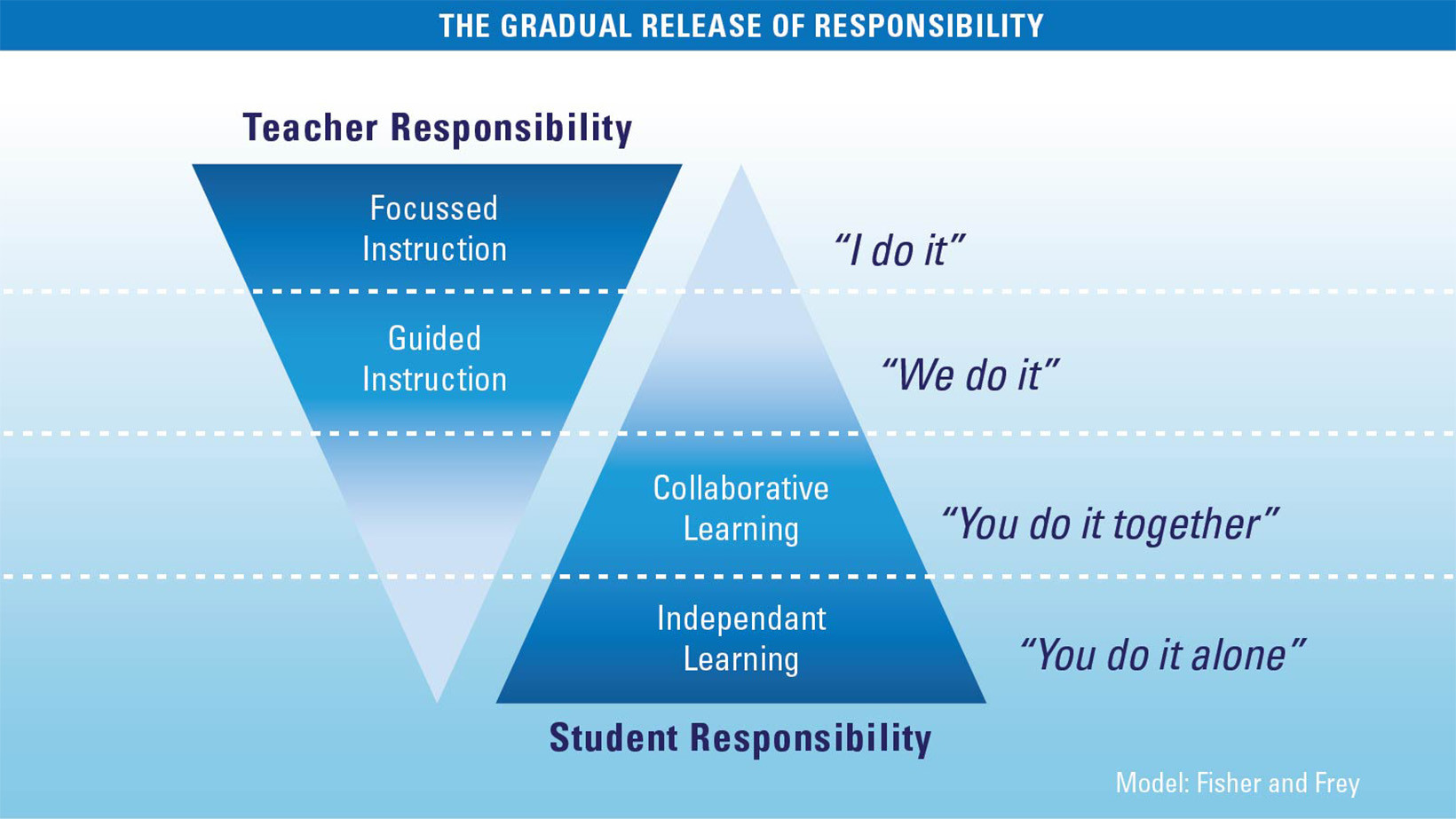
In the Term 1 Newsletter, we looked at the first stage of the Gradual Release of Responsibility model: Focussed Instruction – “I Do It” where the teacher takes the lead in introducing new knowledge and skills. We explored the elements of: Starting with Clear Goals, Keeping it Focussed, Learning by Watching an Expert Think and Setting the Stage for What Comes Next. In the Term 2 Newsletter, we looked at the second stage of the model: Guided Instruction – “We Do It” where the teacher begins to step back a little, and invites students to start practising new skills with carefully targeted support. Rather than simply watching and listening, students now begin to have a go, while the teacher remains close by to guide, prompt, and redirect as needed. We explored the elements of building the Bridge between Modelling and Independence, Meeting Students Where The Are and Building Confidence and Independence.
This term I want to look at the third stage of the model: Collaborative Learning – “You Do It Together.”
STAGE THREE:
Collaborative Learning – “You Do It Together”
Once students have been introduced to new content and practised it with teacher support, they are ready for the next step in the Gradual Release of Responsibility model: Collaborative Learning. This is the stage where students begin working with their peers to apply and extend their learning, with the teacher stepping back further while still remaining available to monitor and support.
Learning From and With Each Other
Collaborative Learning is far more than students simply sitting together in groups. It involves purposeful, structured tasks where students discuss ideas, solve problems, and refine their thinking alongside classmates. Educational researcher Barak Rosenshine identified this kind of peer learning as a valuable feature of effective classrooms, noting that students often achieve more when they have the chance to explain material to one another and receive feedback from someone other than the teacher. Other research by Lev Vygotsky showed that children learn more, and think at a higher level, when they work through problems together rather than alone. Explaining a concept to a peer, comparing approaches, or working through a task as a small group all require students to organise and articulate their understanding in their own words; a process that deepens learning in ways that listening alone cannot.
Practising Without the Teacher Close By
This stage sits between Guided Instruction and Independent Learning. Students are still supported by clear expectations and structures, but they are now responsible for applying skills without the teacher guiding every step. This gentle stretch gives students the chance to test their understanding and build the confidence needed to eventually work things out on their own.
Building More Than Academic Skills
Collaborative Learning is where our College Learner Attribute of Relating truly comes to life – communicating clearly, listening actively, working well in a team, and understanding different perspectives. It also calls on Developing, as students stay curious, reason together, and make connections between ideas, and on Managing, as they plan their contribution, stay focused, and persevere through the challenges of shared work. Beyond these, students build a broader set of collaborative skills: negotiating and compromising when ideas differ, giving and receiving constructive feedback, sharing responsibility for a group’s success and learning to lead in one moment and support in the next. These skills are linked to stronger academic achievement, improved self-esteem, better peer relationships and more confident communication. At St Andrews Christian College, we see stage of Collaborative Learning as forming students who can learn effectively and work well with others; reflecting our commitment to educating the whole child within a community of learners.
Preparing for Independence
Collaborative Learning is, in many ways, the final rehearsal before students step out fully on their own. Working alongside peers allows students to test ideas, hear different ways of approaching a problem, and correct misunderstandings in a low-stakes setting before they are asked to apply a skill entirely by themselves. It also gives them practice in some of the very habits that independent learning demands: taking ownership of a task, managing their own thinking, and persevering when something is difficult, but with the reassurance of peer support close at hand. Over time, the confidence and competence built through this shared practice transfers into genuine independence, as students internalise not only the skill itself but the thinking and self-management strategies that go with it.
Next term, I look forward to sharing more about the final stage of the model: Independent Learning – “You Do It Alone”.
Michael Swanborough
Deputy Principal – Learning and Teaching